
A pivot lateral irrigator is easier to understand once you stop treating the name as a puzzle. It belongs to the family of large lateral-move irrigation machines, but it adds a swing motion at the cart. That swing lets the same span work from a different field position instead of staying only on one straight travel line. For first-time learners, the useful question is not whether the machine sounds advanced, but what the swing changes in real field work. The category makes more sense when you separate three ideas: where it sits among moving machines, how the 180-degree turn works, and what the name still leaves for a specific field layout to answer.
In pressurized irrigation, moving machines are built around a simple idea: a long sprinkler span delivers water while the machine travels. A center pivot rotates around a fixed pivot point. A standard lateral mover travels in a straight line across a field. A pivot lateral irrigator takes the lateral-move idea and gives the span one more degree of freedom at the cart: it can swing around that cart rather than remain locked to a single straight path. That makes it a lateral-move machine with a turning feature, not a center pivot with a different name and not a fixed lateral mover. The cart is the reference point. It carries the span, and during a swing it becomes the point around which the span changes direction. In normal lateral mode, the machine moves forward along the field, irrigating as it goes. When the span rotates, the machine is no longer simply following that straight line; it is repositioning the long arm so that it can line up for the next lateral pass. This is the core category idea. The machine still works as a lateral irrigator, but its field role includes a turn that a standard lateral mover does not perform. The swing is the feature that separates the category in everyday conversation.
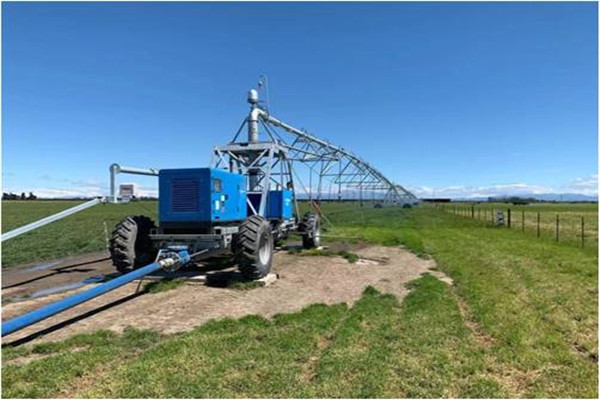
The 180-degree swing is the part that changes how the machine fits into field work. Before the swing, the span is moving along a lateral path. After the swing, it can be aligned to serve the opposite side or another lateral position, depending on how the machine is configured. Water supply must support that motion. A hose-drag system feeds water through a flexible hose connected to a pressurized supply point, while a ditch-feed system draws water from an open channel beside the field. Both are established ways to supply a lateral machine; the right choice depends on the water source and field infrastructure. The swing then brings the span back into lateral mode for the next run.
On a machine set up for this work, the visible sequence is clear. The span reaches the end of a lateral run or a planned turn area. The cart becomes the center of rotation, and the span swings around it through 180 degrees. Once the span is aligned with the next lateral path, the machine returns to lateral mode and continues irrigating. In the Irritech Pivot Lateral Irrigator example, the machine is configured to rotate around the cart and then automatically resume lateral mode. That automatic return matters because the swing is not an end in itself. The purpose is to put the long span back into a productive travel line, with the cart and the span working together again.
Internal and external rotation describe which side of the field the span serves after the turn. With internal rotation, the span swings toward the inner side of the turn area. With external rotation, it swings toward the outer side. A machine can be set up with both ends rotating internally, both ends rotating externally, or one end internal and the other external. These are layout choices, not quality levels. They affect how the span approaches the next pass and how much room the turn needs at the field edge. The design can serve opposite sides of a field, and some descriptions treat that as doubling coverage potential; the real result depends on field geometry and machine configuration.
The name tells you the category and the swing feature. Span length, pipe diameter, machine weight, flow requirement, pressure requirement, and the exact component list belong to a particular configuration rather than to the category label itself. Those details change from one field to the next. A machine built for a wide field may need a different span layout from one built for a narrower block. The water supply also changes the practical setup. A hose-drag machine needs a hose route and connection points, while a ditch-feed machine needs a channel, an intake arrangement, and water conditions that suit the system. Field geometry is the reason the name alone cannot answer everything. A 180-degree swing needs space at the turn area. The field must allow the span to rotate without hitting obstacles, and the machine must be able to line up with the next lateral path. Field width, headland room, water source position, and the chosen rotation side all shape what the machine can do in practice. That is why a useful conversation with an irrigation equipment supplier or irrigation system manufacturer starts with the field layout, not just the product name. The same category can be built in different widths and configured for different water supply methods.
A pivot lateral irrigator is a lateral-move irrigator with a span that can swing 180 degrees around its cart. That swing lets the machine change sides or line up for another lateral pass, then return to normal lateral travel. It is not a center pivot, and it is not a fixed lateral mover. The practical value depends on field shape, turn space, water supply, and the chosen rotation configuration. As an observed example, Irritech Global Irrigation Solutions presents a pivot lateral irrigator with internal, external, or mixed rotation, hose-drag or ditch-feed supply, and automatic lateral resume. Readers can explain the category in their own words once they connect those three parts: the lateral path, the cart-centered turn, and the return to lateral mode.
A: A standard lateral move irrigator travels along a straight lateral path and stays tied to that line during normal work. A pivot lateral irrigator keeps the lateral-move structure but adds a span that can swing around the cart. That swing allows the machine to reposition the long span for another lateral pass, including the opposite side of a suitable field layout. The moving irrigation work is still lateral; the difference is the cart-centered turn between passes.
A: The 180-degree swing matters because it changes the machine from a single-line lateral mover into a machine that can re-aim its span. At the turn area, the span rotates around the cart, lines up with the next lateral path, and returns to lateral mode. In layouts that fit the machine, this can reduce the need to treat each side of the field as a separate lateral job. The benefit comes from the geometry and configuration, not from the name alone.
A: Yes. The category supports both hose-drag and ditch-feed supply. Hose drag uses a flexible hose connected to a pressurized water point and is common where a hydrant or pipeline route is already available. Ditch feed draws water from an open channel and depends on a suitable intake, water level, and filtration arrangement. The better choice follows the field’s water source, layout, and operating preferences.
University of Nebraska-Lincoln Extension: Center Pivot and Linear Irrigation Management
Extension publications | University of Idaho
Irritech Global Irrigation Solutions Pivot Lateral Irrigator
2021©Privacy PolicyTheme byIrritech


