
A pivoting lateral machine looks settled on a plan drawing: a long truss, a cart in the middle, a straight run down the field. The interesting part happens at the edge, where the truss stops travelling sideways and swings around instead. Design learners often treat that drawing as finished once the field width is known. Rotation direction is what turns a width into a working layout, because a 180-degree swing needs clear, firm, obstacle-free ground on one side or the other, and which side that is changes everything about how the field edge gets organised.
The headland is the band of ground at the field edge where a travelling machine stops irrigating in a straight line and prepares for the next move. On a pivot lateral irrigator, that band carries more than a wheel track. It holds the cart, the outer end of the truss, and the water intake line feeding the machine, and it is where the span pivots before it lines up on a new pass. Rotation direction answers one practical question: when the truss swings, which side does it swing toward? Headland clearance follows from that answer, because the arc of a long steel span has to land on ground that is level, open and clear enough to accept it. The swing is a confirmed part of the machine's design: the linear truss rotates 180 degrees around the cart, and once the turn is complete the machine resumes normal lateral travel. What changes between one layout and another is where that half-circle sits relative to the field boundary. Two machines of the same span length can need very different headland strips, depending on whether the truss sweeps inward over the irrigated block or outward over the edge of the property.
Internal rotation swings the truss toward the inside of the block, over ground the machine already irrigates. The turning arc therefore sits on the field side, and the strip beyond the boundary does not have to swallow the full sweep. What the layout gains in a narrower outer margin it gives back in housekeeping inside the field, because the swing path crosses the corner that will be worked next. That corner has to be free of fences, poles, trees and wet low spots at the moment of the turn. The useful habit when reading a layout is to sketch the half-circle on the field side first, then see what the arc covers.
External rotation reverses the geometry. The truss swings outward, so the half-circle lands on the outer strip between the crop edge and the boundary. That keeps the irrigated block clean during the turn, which matters where the crop runs right up to the line, but it shifts the demand onto the outer headland. That strip has to be wide, firm and clear enough to take the sweep, and it stays out of production for the life of the machine. Mixed-end layouts exist because plenty of fields offer room outside the boundary at one end and only room inside at the other.
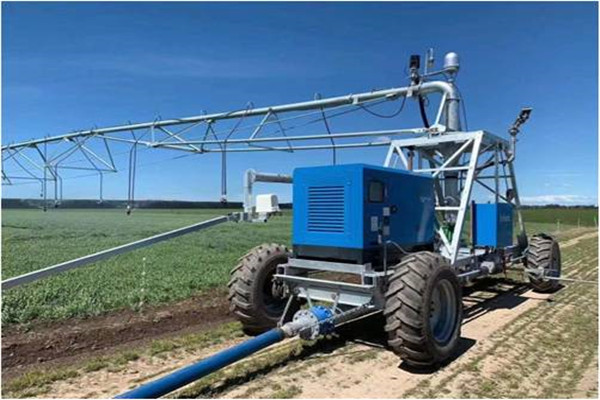
Machines in this class are offered in three arrangements: internal rotation at both ends, external rotation at both ends, and one end internal with the other external. The Irritech Global Irrigation Solutions pivot lateral irrigator page lists all three as available configurations, alongside the 180-degree swing itself. Read each arrangement through two questions rather than through a parts list. First, which side does the truss swing toward at each end? Second, which strip of ground does that arc leave free for the rest of the work — the harvest turns, the water line, the machinery that has to cross the headland every few days? With internal rotation at both ends, the two working corners sit inside the field, so the outer margin can stay modest along the whole boundary. The trade is that both field-side corners become active turning zones and have to be kept clear all season, not just on the day the machine arrives. With external rotation at both ends, the outer margin at each end has to be generous, in exchange for crop-side corners that stay untouched. That pattern suits fields where a road verge, a dry ditch bank or a strip of fallow already sits outside the crop line at both ends. The mixed arrangement is the one that most changes how the field is understood. Once one end swings inward and the other swings outward, the two headlands stop being mirror images. They become two different working zones with different clearance, different obstacle rules and different marking on the ground, so a layout that assumes symmetry will mislead the person operating the machine. Mixed rotation fits fields where one boundary has spare ground and the other does not, and it rewards a designer who walks both ends before drawing anything.
The arc does not have a fixed size. It grows with the length of truss extending past the cart, so a machine with a long overhang sweeps a wider half-circle than a short one in exactly the same rotation direction. Anything mounted on that outer end adds to the envelope. This is why the same rotation direction can look generous on one farm and tight on another, and why headland figures belong to a specific machine-and-field pairing rather than to a configuration name. Steering and sequencing also belong to the project. How the machine holds its line across the headland, in what order the swing and the travel stop are commanded, and where the stop point sits relative to the boundary are all defined per site, together with the exact turning radius and headland dimensions. General mobile irrigation machine safety thinking, such as the European EN 908 framework, points in the same direction: a moving irrigator needs room to stop, to be seen and to be reached, so the headland is a safety zone as much as a mechanical one. Treat a layout sketch as the concept, and let the site survey set the distances.
Reading rotation direction as a question about swing side turns an abstract configuration label into something you can picture on the ground. Internal rotation puts the half-circle over the irrigated block and keeps the outer margin tight; external rotation pushes it onto the outer strip and leaves the crop side clean; mixed rotation asks you to design two different headlands instead of one mirrored pair. Configuration details like these are usually confirmed with the irrigation system manufacturer or an irrigation equipment supplier who can tie the arrangement to a specific field width and boundary. Start from the side the truss swings toward, and the rest of the layout follows.
A: The difference is which side of the field edge the truss sweeps over during its 180-degree swing. Internal rotation swings the span toward the inside of the irrigated block, so the turning arc uses field-side ground. External rotation swings it outward, so the arc lands on the strip between the crop edge and the boundary. Headland clearance, obstacle clearing and corner marking all shift with that direction.
A: Internal rotation lets the outer margin stay narrower because the sweep happens inside the field, but the field-side corner becomes an active turning zone that must stay clear. External rotation needs a wider outer strip while leaving the crop-side corner untouched. In practice the choice follows the ground you already have: spare room outside the boundary at an end favours external rotation, and a planted corner with no outer space favours internal.
A: Yes. Mixed rotation, with one end swinging inward and the other swinging outward, is a confirmed configuration on these machines. It suits fields where the two boundaries offer different ground, for example a road verge at one end and a planted corner at the other. The practical consequence is that the two headlands need separate clearance checks and separate marking rather than a mirrored design.
University of Nebraska-Lincoln Extension: Center Pivot and Linear Irrigation Management
Extension publications | University of Idaho
European, American and International Standards online - iTeh Standards
Irritech Global Irrigation Solutions Pivot Lateral Irrigator
2021©Privacy PolicyTheme byIrritech


