
For someone learning how large irrigation machinery works, the natural first question is mechanical: how does the truss travel, how does it swing at the headland, how does water reach it. The electrical side is less visible and often gets skipped, even though it decides whether the mechanical side can run unattended. A machine crossing a field at night or in a light rain offers no obvious clue about which of its internal checks are closed and which have failed. Understanding safety circuits, status indication, and stop logic closes that gap and makes the rest of the machine legible.
A lateral irrigator in motion looks calm from a distance: truss spans gliding forward, sprinklers running, one cart carrying the whole machine down the field. That calm hides a long set of conditions that all have to hold at once. Each drive tower needs to stay on its line, spans need to stay roughly aligned, water has to keep arriving through a hose drag or a ditch feed, and at the headland there must be room for the truss to swing 180 degrees around the cart. A start and stop switch controls power. It says nothing about whether any of those conditions are still true. That is the gap a safety circuit fills. The underlying idea is simple: a fault should stop motion before it becomes damage. European safety work on mobile irrigation machines, published as EN 908, treats risk control as a design responsibility rather than an operator skill, and that framing is the right way to read any control system on these machines. The circuit exists so that nobody has to make a last-second judgment about a span that has drifted out of line or a tower that has stopped while the rest of the machine kept moving. On a pivoting lateral, the practical version of this is a monitoring chain. Switches and sensors along the machine watch the conditions that matter: tower position and alignment, end-of-travel position, drive status, and the conditions that apply during the headland turn when the truss rotates around the cart. Every link in that chain has to stay closed for travel to continue. When one link opens, the chain is broken and the stop logic takes over. Learners often picture a safety circuit as a single emergency button; in practice it is a loop of checks, and the loop is what allows a machine to keep moving with only occasional human attention. That structure also explains why the water supply arrangement matters to the electrical design. A hose drag keeps the machine tethered to a fixed hydrant, while a ditch feed lets it draw from an open channel along the run. Each imposes different limits on how far the machine can travel and where it can turn, and those limits are part of what the control system is managing. The mechanics and the control logic are one system, not two.
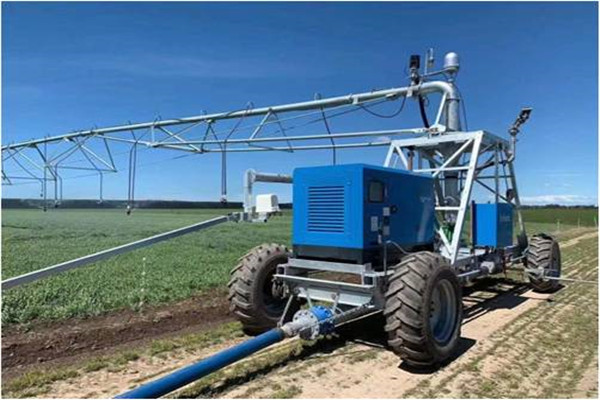
Because the monitoring chain is invisible, the control box does most of the communication. It sits between the machine and the person watching from the field edge, converting circuit state into something readable at a glance: power and mode status, whether the safety loop is closed, which tower or span is involved when it is not, and what the machine was doing just before it stopped. None of this replaces walking the line. It shortens the walk. Instead of checking every tower in sequence, an operator can head straight for the section the box identifies, which matters most when the machine stops several hundred meters from the access track.
A light mounted on a tower box is the simplest form of status indication, and it is worth understanding why it earns its place. When a safety loop opens at a specific tower, the machine stops and the reason sits inside a box that may be far from where anyone is standing. A warning lamp turns that tower into a visible marker: the machine now has a location associated with the fault instead of just a halt. Irritech's tower-box design, which pairs a safety-circuit indicator with a QR entry for troubleshooting, shows how this can be packaged; treat it as an example of the approach rather than a fixed layout across every build. The secondary benefit is social rather than technical. A stopped machine with an illuminated warning is legible to anyone nearby as deliberately stopped, not abandoned or broken down. That matters on a farm where several people may pass the same machine in a day and where the difference between waiting and intervening should be obvious without a phone call.
The symptom is always the same: the machine stopped in the middle of a run. The cause could be a misaligned span, an opened switch on one tower, a rotation condition that was never satisfied, or a water supply problem upstream. Without any indication, those possibilities look identical from the cab or the field edge, and the search starts from zero every time. A code, a lamp, or a scannable entry that points at a specific circuit segment collapses that search into a short walk to a known place. This is also where documentation quality shows. A machine from an irrigation system manufacturer that labels circuit segments consistently and keeps the matching fault list with the machine makes fault indication genuinely useful, because the number on the display maps to a described condition rather than an internal reference nobody can interpret. What each code points at depends on the documentation for that specific build, and the wiring and control logic behind it belong with the technical documents supplied for the model.
Stop logic is the part most worth understanding, because it decides what happens at the exact moment a check fails. The governing rule is that any break in the monitoring chain should bring travel to a controlled stop rather than let the machine continue on partial information. On a pivoting lateral, the highest-stakes moment is the headland rotation, when the truss swings around the cart. Clearance, alignment, and the water connection all behave differently during that swing than they do during straight travel down the field. Stop logic supplies the interlock: if the rotation conditions are not satisfied, travel stops instead of pushing on into a geometry the machine was not set up for. Industrial control practice treats monitoring and transitions to a safe state as core system functions rather than accessories bolted on afterwards. NIST's material on industrial wireless systems makes that point at plant scale, and the same reasoning holds for a farm machine working alone in a field. A stop that happens at the right moment costs a few minutes; a stop that happens too late costs a span, a gearbox, or a season's schedule. Extension guidance on linear irrigation management is built around consistent, complete passes, and a machine that protects itself is also a machine that finishes its passes. Fault indication and stop logic are usually discussed together because they complete one loop. The machine notices a broken condition, stops in a controlled way, reports where the problem sits, and leaves the judgment to a person. Nothing in that loop asks the operator to watch the machine constantly, and nothing in it assumes the machine can diagnose itself. It is a division of labor, and understanding the division is the real point of learning how these control systems work. Whether a stop should also block restart until a person resets it, and how that is arranged, comes down to the build and its documented configuration.
Safety circuits, control boxes, and stop logic are the quiet layer that makes automatic travel on a pivoting lateral possible. The circuit watches the conditions that keep a moving machine safe, the box makes those conditions visible from ground level, and the stop logic decides when movement should end. Read together, they explain why these machines can run with limited supervision without asking anyone to guess. For readers comparing configurations, the documented control and indication details for the Pivot Lateral Irrigator are a useful next stop, since they show how these functions appear on an actual machine.
A: A traveling machine has many conditions that must stay true at once: tower alignment, span position, drive status, and clearance for the 180-degree turn at the headland. A safety circuit monitors that chain continuously and stops travel when any link opens. Without it, a single drifted tower could keep being pushed by the rest of the machine, turning a small correction into structural damage.
A: It shows the machine's current state in readable form: power and mode, whether the safety loop is closed, which tower or span is involved when it is not, and what the machine was doing before it stopped. That indication tells an operator where to look first instead of walking the full length of the machine to find the fault.
A: They put the fault at a location. A lamp on a tower box marks the tower where the circuit opened, and a fault message or scannable entry points to a specific circuit segment. Anyone approaching the machine can tell that it stopped deliberately and roughly where the issue sits, which shortens the walk and reduces the chance of someone stepping into a moving span to investigate.
EN 908:1999+A1:2009 Agricultural and forestry machinery — Mobile irrigation machines — Safety
Industrial Wireless Systems | NIST
Center Pivot and Linear Irrigation Management | University of Nebraska-Lincoln Extension
Irritech Global Irrigation Solutions — Pivot Lateral Irrigator
2021©Privacy PolicyTheme byIrritech


