
A large-field grower needs to know how a pivot lateral irrigator moves across one side of a field, turns at the edge, and returns ready for the next pass. The practical question is whether one machine can cover both sides without adding a second unit. For a pivot lateral irrigator, the answer lies in the operating path. The machine moves like a linear irrigator during the main run, then uses its cart as the turning point at the field edge. The span swings 180 degrees, changes direction, and automatically returns to lateral mode. That sequence shapes how you plan field width, headland space, and water supply before asking for a layout review.
A long, rectangular field gives a pivot lateral irrigator a clear job to do. The machine can make a straight lateral pass along one side, turn at the field edge, and work the opposite side on the return route. Long runs reduce the number of interruptions, and a consistent field width makes the span layout easier to set. If the water source already runs along the field or connects to a hose route, the machine can follow a simple operating line instead of crossing odd corners or making repeated short moves. Irregular fields are harder to plan because the machine still needs a clean cart path, a usable turning area, and a clear direction change at the boundary. A narrow corner or an angled headland can force extra travel or leave part of the field outside the practical route. That is why a rectangular field is often the first place growers look at a pivoting linear or swing around linear design. The shape supports the mechanical sequence: travel, rotate, reverse, and return to lateral mode. The simpler the boundary, the easier it is to match the machine to the field.
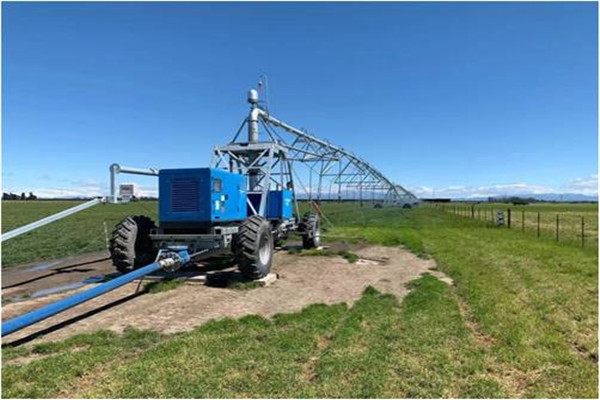
The working sequence is easier to picture once you separate the two modes. In lateral mode, the linear span travels across the field with the cart carrying the machine along its path. When the cart reaches the field edge, the machine stops its forward run and begins the rotation. The span moves around the central cart, the machine changes direction, and then it returns to lateral mode for the next pass. The Irritech Pivot Lateral Irrigator uses a linear span that can swing 180 degrees around the cart and then automatically returns to lateral mode. It can be configured for internal rotation at both ends, external rotation at both ends, or one internal and one external. Because the rotation affects both the cart position and the clear space at the field edge, the field boundary and headland should be reviewed together.
The central cart is the pivot point during the turn. The span swings around that cart to line up for the next direction of travel. Before layout review, the grower should mark the cart path, the clear area at the field edge, and any obstacle that could sit inside the turning space. Headland clearance matters here. The turn needs open ground, and the water connection needs to stay reachable during and after the swing. Marking these areas early gives the manufacturer a clearer picture of how the machine will sit in the field and where the rotation can take place.
After the 180-degree swing, the machine automatically returns to lateral mode. That return is what makes the next pass practical: the span lines up along the field and resumes the straight lateral run instead of leaving the grower to reset the whole machine. The field boundary, water supply position, and operating route still need to be planned as one system. A hose drag supply needs a route that follows the turn; a ditch feed supply needs the intake side to stay aligned with the machine. When those pieces match, the return to lateral mode keeps the work flow simple.
Field length and field width set the basic working envelope. Field length tells the machine how long each lateral pass will be and where the cart will travel. Field width helps define how much span is needed and whether the machine can work both sides without awkward gaps. Headland space at the field edge is just as important because the span needs room to swing around the cart. The water source position also belongs in the same review. A hose drag or ditch feed connection that sits in the wrong place can make a simple turn harder to manage, even when the field itself looks regular on a map. The route needed to cover both sides of the field should be reviewed with the same care. A grower may see a wide rectangular field, but the machine needs a route that works at both ends, not just in the middle. Field width is custom-configured, so the span layout is reviewed against the actual field dimensions and final configuration. Final span length, pipe size, flow, pressure, and component fitment all come from the field dimensions and final configuration. The design lets one machine work both sides of a field; any doubled-coverage result depends on field shape and final configuration. A custom field-width review is the practical next step before asking an irrigation equipment supplier for a formal layout.
A pivot lateral irrigator works by combining a straight lateral pass with a 180-degree swing around its central cart. The machine reaches the field edge, rotates, changes direction, and automatically resumes lateral mode for the next pass. The field should suit that motion: a long rectangular shape, clear headlands, a sensible cart path, and a water supply that fits either hose drag or ditch feed. If you are evaluating this system for a large field, start with a field sketch that shows length, width, edge clearances, cart path, and water source location. An irrigation system manufacturer can use those details to review the layout, set field-width customization, and explain the next configuration step. Irritech Global Irrigation Solutions can review your field dimensions and discuss a custom layout for the Irritech Pivot Lateral Irrigator.
A: It makes a lateral pass on one side, reaches the field edge, swings 180 degrees around the central cart, and then works the other side on the return pass. The machine returns to lateral mode after the turn. Any doubled-coverage result depends on field width, field shape, and final configuration.
A: The machine changes direction and automatically returns to lateral mode. The next pass then runs along the opposite side of the field. The field boundary, headland space, and water connection should be planned together so the turn and return pass line up with the operating route.
A: Review field length, field width, headland space at the edges, cart path, water source position, and the route needed to serve both sides. Also identify whether the supply will be hose drag or ditch feed. These details let the manufacturer review span layout, field-width customization, and the final configuration.
University of Nebraska-Lincoln Extension: Center Pivot and Linear Irrigation Management
2021©Privacy PolicyTheme byIrritech


